
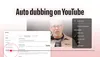
YouTube’s six million daily auto-dub viewers signal a wider global Community opportunity for English-language Nollywood films and their producers.
YouTube’s automatic dubbing expansion could change how international audiences discover English-language Nollywood films. On February 4, 2026, the platform announced that auto dubbing had expanded to 27 languages—and revealed that more than six million viewers watched at least 10 minutes of auto-dubbed content daily in December 2025.
That figure covers YouTube as a whole, not Nollywood specifically. Even so, it points to an established appetite for watching videos across language barriers, potentially giving Nigerian filmmakers another route into a wider global Community.
Nigerian channels already attract international audiences
The opportunity matters because Nigerian YouTube content is already travelling. Google reported that more than 70% of watch time on Nigerian YouTube channels comes from outside Nigeria. At a March 2026 workshop for African filmmakers, the company specifically recommended automatic dubbing as a tool for reaching new geographies.
For Nollywood producers releasing films on YouTube, dubbing could make discovery less dependent on English fluency or subtitles. Viewers can choose between original and dubbed audio tracks and set preferred languages, allowing the same upload to serve different audiences without creators publishing multiple editions.
English-language Nollywood has the clearest opening
YouTube’s current documentation lists 20 automatic dubbing targets for eligible English-language videos. They include French, Spanish, Portuguese, Arabic, Hindi, German and Japanese. Expressive Speech, designed to better reproduce a speaker’s tone and delivery, is available across all channels in eight languages, including English, French, Hindi, Portuguese and Spanish.
This makes English-language Nollywood films the clearest immediate use case. Yoruba, Igbo, Hausa and Nigerian Pidgin are not listed as supported source languages in the current documentation. Films longer than 120 minutes may also be ineligible, creating an important consideration for producers planning YouTube release strategies.
Access does not guarantee audience growth
Automatic dubbing can open a door, but it cannot guarantee views. YouTube warns that generated tracks may mishandle accents, dialects, idioms, names or audio affected by background noise. Those limitations are especially relevant for films whose humour, emotion or cultural meaning depends on precise delivery.
Creators can preview or manually review tracks before publication, while YouTube Studio’s audio-track filter allows channels to compare performance by language. Used carefully, that data could show Nollywood producers where dubbed films are finding genuine interest rather than encouraging a one-size-fits-all rollout.
The bigger audience trend is clear: multilingual viewing is becoming a normal part of YouTube. For Nollywood, thoughtful dubbing could extend existing international momentum while preserving the performances and cultural detail that make its stories distinctive.
Join the conversation
Which languages should English-language Nollywood films prioritise when using YouTube’s automatic dubbing feature?
Share your thoughts in the comments below.
Sources
Source links used to research and verify this article:
YouTube BlogYouTube Blog: Auto Dubbing Explained
YouTube Help
Google Africa Blog

No comments:
Post a Comment