
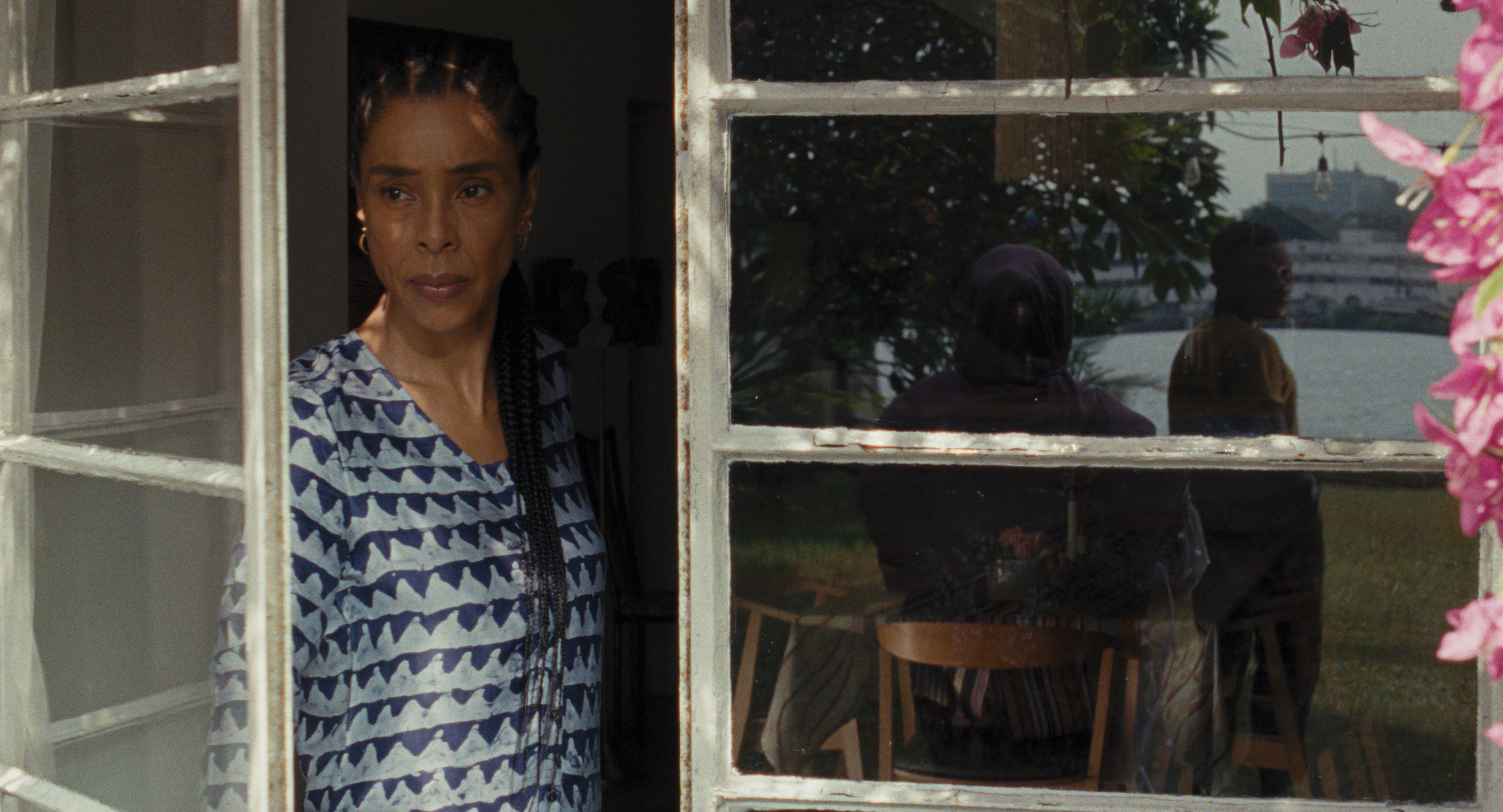
Clarissa relocates Mrs Dalloway to Lagos, pairing Sophie Okonedo’s performance with a vivid 35mm study of memory, privilege, Nigerian trauma and regret.
Clarissa arrives with the kind of international attention that can expand expectations of Nigerian cinema. Directed by twin filmmakers Arie and Chuko Esiri, the film premiered in the 2026 Cannes Directors’ Fortnight before appearing at the New York Film Festival and BFI London Film Festival. Its ambition is equally striking: relocating Virginia Woolf’s Mrs Dalloway to contemporary Lagos.
This Movie Review finds the adaptation’s most compelling decision in its use of Lagos society to examine memory, privilege and roads not taken. Rather than treating Woolf’s novel as a museum piece, the Esiri brothers make its emotional questions feel connected to Nigerian history and the carefully maintained surfaces of elite life.
A party opens the door to the past
Sophie Okonedo plays Clarissa, an affluent woman preparing to host a party as memories of old friends, former relationships and unrealised ambitions interrupt her present. India Amarteifio portrays the younger Clarissa, giving the character’s recollections a separate physical presence rather than leaving them as distant exposition.
That dual casting strengthens the film’s central tension. The older Clarissa appears surrounded by comfort, yet her memories suggest that status cannot silence regret. Okonedo’s performance has been singled out in critical notices, and the role gives her space to convey the unease beneath Clarissa’s polished social identity.
David Oyelowo, Ayo Edebiri, Toheeb Jimoh and Fortune Nwafor also feature, bringing together internationally familiar performers without weakening the story’s specifically Nigerian setting.
Private regret meets collective trauma
A parallel narrative follows Septimus, a soldier haunted by violence and trauma. His presence broadens the film beyond one wealthy woman’s reflections, connecting intimate distress to the wounds carried by a society. The contrast also prevents privilege from becoming merely decorative: Clarissa’s protected world exists alongside suffering that cannot be managed like a guest list.
Jonathan Bloom’s 35mm cinematography, shot in Lagos and Delta State, has also attracted critical praise. The format suits a story concerned with remembrance, allowing Nigeria’s locations to function as more than an updated backdrop. Lagos becomes part of the adaptation’s argument about class, aspiration and what people choose to forget.
A Nigerian adaptation with global reach
Clarissa demonstrates how African filmmakers can engage canonical literature without surrendering cultural specificity. Its festival journey and NEON’s worldwide distribution acquisition give the film an important route to diaspora and international audiences. A select United States theatrical release is scheduled for December 11, 2026.
The film’s strongest achievement is its refusal to separate personal memory from social history. By placing Woolf’s framework inside Lagos, the Esiris turn an interior drama into a Nigerian reckoning with privilege, gender, regret and collective trauma.
Join the conversation
Does relocating a literary classic to contemporary Lagos make you more interested in seeing Clarissa?
Share your thoughts in the comments below.
Sources
Source links used to research and verify this article:
NEONBFI London Film Festival
Directors’ Fortnight
The Nollywood Reporter
NEXT Magazine

No comments:
Post a Comment